Guides · The interview
What actually happens in the naturalization interview
The N-400 review, the English test, the civics questions and the form you walk out with, in the order they happen.
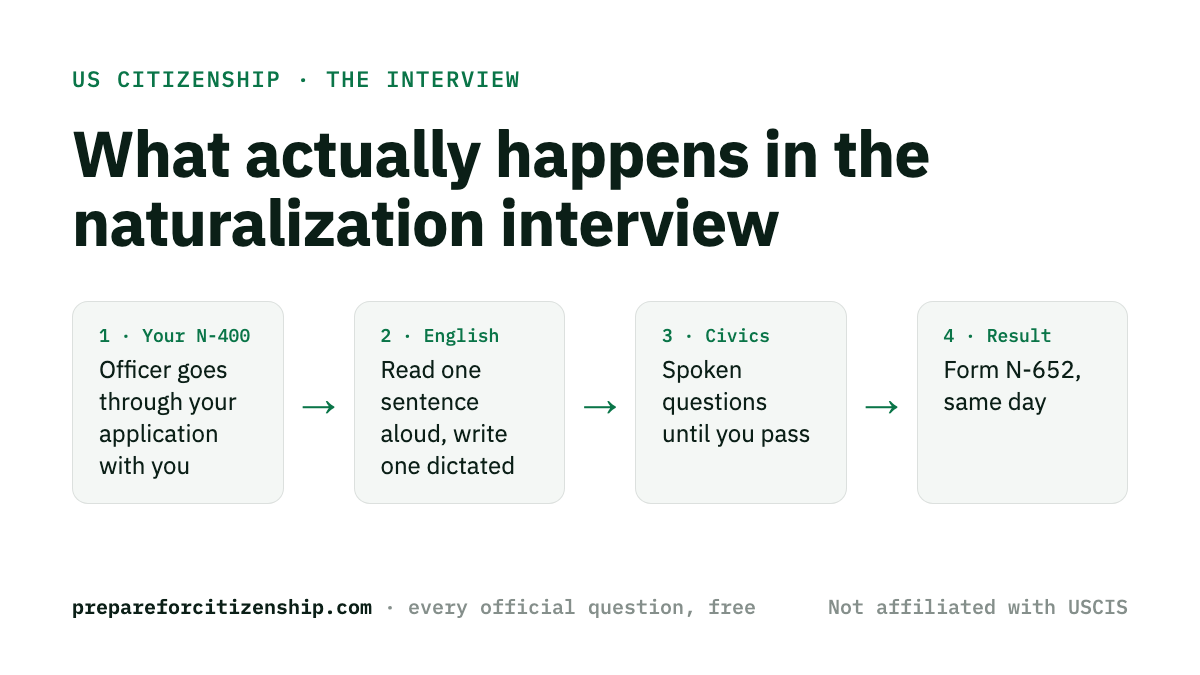
Most of the anxiety about the citizenship interview comes from not knowing the shape of it. The shape is very consistent. Here is what happens, in order, and what each part is really testing.
Before you sit down
You check in, show your appointment notice and green card, and wait. Bring the originals of anything you uploaded or mailed: passport, green card, tax transcripts, and for marriage-based cases, evidence that the marriage is real.
Many recent applicants report that the officer reviewed only what had been uploaded to the USCIS online account and never opened the paper binder. Upload your recent evidence there before the interview, and bring the binder anyway.
Step 1: the oath and your N-400
The officer places you under oath, then goes through your application with you, page by page. This is the longest part and it does two jobs at once. It confirms your answers are still true and asks what has changed since you filed: trips abroad, addresses, jobs, any arrests or citations. And it is the spoken English test. USCIS says the officer evaluates your ability to speak and understand English throughout the eligibility interview.
Answer plainly and truthfully. If something has changed, say so. If you do not understand a question, ask the officer to repeat or rephrase it. That is normal and allowed.
Step 2: reading and writing
The officer shows you a sentence to read aloud. You must read one sentence correctly, and you get up to three tries with different sentences. Then the officer dictates a sentence and you write it down, again one correct out of up to three. The vocabulary comes from USCIS's published reading and writing lists, and the sentences are short and civic.
Applicants report sentences such as Who can vote in federal elections? for reading and Only U.S. citizens can vote in federal elections. for writing. That is the register. The English test guide covers exactly how it is scored.
Step 3: the civics questions
The officer asks the civics questions out loud, one at a time, and you answer from memory. You do not read them and you do not need full sentences; a few words is fine. Any answer on USCIS's accepted list counts, and you only need one of them.
The officer stops as soon as the result is decided. On the 2008 test that is 6 right or 5 wrong out of up to 10. On the 2025 test it is 12 right or 9 wrong out of up to 20. Which version you get depends on when USCIS received your N-400, before or after October 20, 2025.
Step 4: the result
At the end you receive Form N-652, Naturalization Interview Results. It tells you whether you passed the English and civics tests and whether your case is approved, continued, or denied. Continued usually means the officer needs a document or a supervisor's review. It is not a denial.
If you fail either test, USCIS schedules a second interview between 60 and 90 days after the first, and you retake only the part you failed. The test version stays the same as the first time.
How long it takes
Applicants commonly report 20 to 30 minutes in the room. The civics part is often the shortest, because a strong start ends it early.
How to prepare for the shape of it
Say the answers out loud, not just in your head. Practice in the real format, with the real question count and pass line for your version, so that stopping early feels normal rather than alarming. And hear the questions spoken before your interview. The first time should not be in that chair.
Frequently asked questions
What form do I get at the end of the naturalization interview?
Form N-652, Naturalization Interview Results. It records whether you passed the English and civics tests and whether your case is approved, continued, or denied.
What happens if I fail the civics test at my interview?
USCIS schedules a second interview between 60 and 90 days after the first. You retake only the part you failed, on the same test version as the first time.
Can I ask the officer to repeat a question?
Yes. Asking the officer to repeat or rephrase a question is normal and allowed, and it does not count against you.
Study the official questions, free
Both versions of the civics test, the answers for your state, and practice tests in the real format with the real pass line.
Prepare for Citizenship teaches the test; it does not advise on applications. Anything about your own case belongs with your lawyer or USCIS. Spotted something wrong? Tell us.