Guides · The answer key
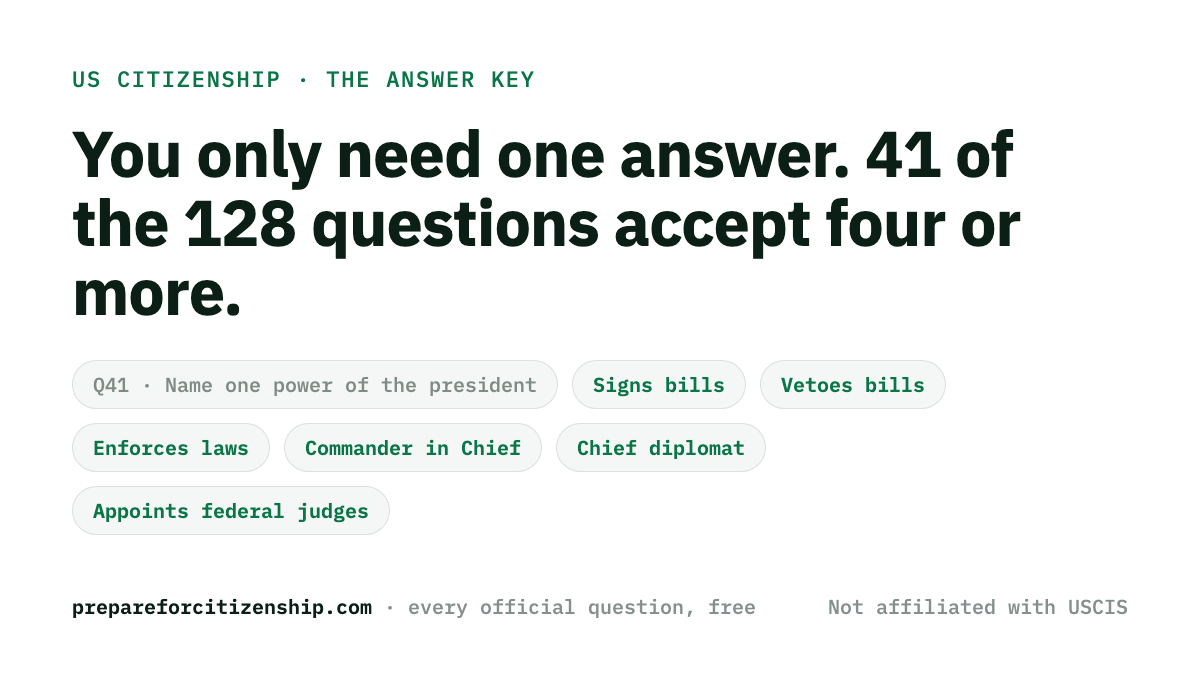
You only need one answer. 41 of the 128 questions accept four or more.
How the USCIS answer key works, what "name one" really means, and why it should change how you study.
A lot of people study the civics test as if every listed answer were required. They see "Name one power of the president" followed by six answers and try to memorize all six. That is more than double the work the test asks for, and it is the main reason the list feels so long.
How the answer key actually works
For each question USCIS publishes a list of accepted answers. The officer accepts any answer on that list. If the question asks for one thing, one accepted answer is a full mark. If it asks for two or three, you need that many, and any two or three from the list will do.
On the 2025 test, 41 of the 128 questions accept four or more answers. Some examples, straight from the key:
- Name one power of the president. Six accepted answers: signs bills into law, vetoes bills, enforces laws, Commander in Chief, chief diplomat, appoints federal judges. You need one.
- Many documents influenced the US Constitution. Name one. Eight accepted answers, from the Declaration of Independence to the Mayflower Compact to the Iroquois Great Law of Peace. You need one.
- What are two Cabinet-level positions? Twenty-two accepted answers, every Cabinet secretary plus the Vice President and several agency heads. You need two.
- Name one power that is only for the states. Five accepted answers, including providing schooling, issuing driver's licenses, and approving zoning. You need one.
- What is the rule of law? Four accepted phrasings, all of which mean no one is above the law. Any one counts.
What this means for studying
Pick your answer. For each multi-answer question, choose the single accepted answer that is easiest for you to remember and say, and make it your answer every time. For the president's powers, "signs bills into law" is a perfectly good permanent answer. For documents that influenced the Constitution, "Declaration of Independence" is one you already know.
You are allowed to be boring. Nobody gets extra credit for "Iroquois Great Law of Peace." You get the same mark for the answer you will not forget under pressure.
For "name two" and "name three" questions, learn one more than required, so a blank on one of them does not sink you.
Read the question for the number
The one trap here is answering with fewer than asked. "What are three rights of everyone living in the United States?" needs three. Six are accepted, including freedom of speech, freedom of religion and freedom of assembly. Give three, then stop.
Watch the wording, not just the number
A few questions look similar but ask different things. "Name one power that is only for the federal government" and "Name one power that is only for the states" sit next to each other, and the answers do not overlap. Declaring war is federal. Issuing driver's licenses is a state power. Learn them as a pair.
The four that vary by person
The state-specific questions, your governor, one of your senators, your representative and your state capital, are marked "answers will vary" on the key. The officer has your correct answer. For the senator question, either of your state's two senators counts. The state questions in full.
In our study material every accepted answer is shown, and you can pick the one you want to drill, so your practice tests reflect the answer you will actually give.
Frequently asked questions
Do I need to give every answer listed for a civics question?
No. If the question asks for one thing, any one answer on USCIS's accepted list is a full mark. If it asks for two or three, give that many.
How many civics questions accept more than one answer?
On the 2025 test, 41 of the 128 questions accept four or more answers, and many more accept two or three.
Study the official questions, free
Both versions of the civics test, the answers for your state, and practice tests in the real format with the real pass line.
Prepare for Citizenship teaches the test; it does not advise on applications. Anything about your own case belongs with your lawyer or USCIS. Spotted something wrong? Tell us.