Guides · The oath ceremony
You passed. Here is what happens at the oath ceremony.
The N-445 notice, the questionnaire on the back, what you hand in, what you get, and the three things to do in the week after.
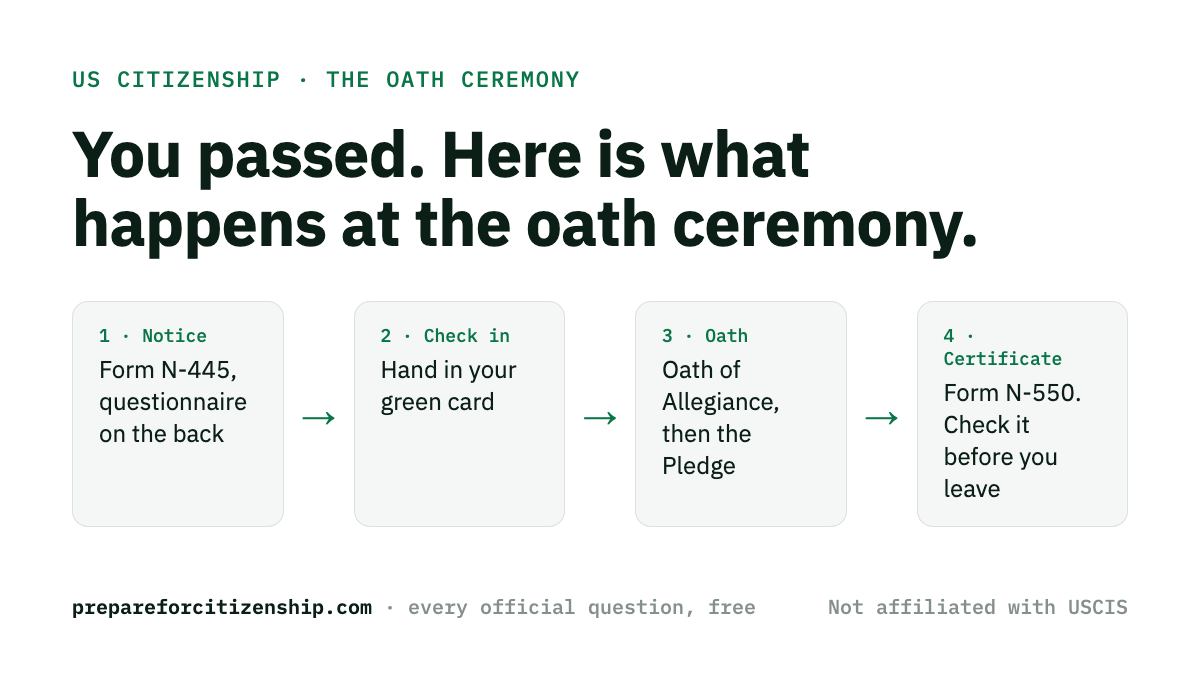
Passing the interview is not the end. You are not a US citizen until you take the Oath of Allegiance at a naturalization ceremony, and the ceremony has its own paperwork, its own order of events and a few traps. Here is the whole thing, from the notice to the passport.
The notice
Some offices can swear you in the same day as your interview. If not, USCIS mails Form N-445, Notice of Naturalization Oath Ceremony, with the date, time and place. On the back is a short questionnaire about what has happened since your interview: travel outside the country, arrests, changes in marital status and the like. Fill it in before you arrive, truthfully. An officer reviews your answers at check-in.
If you cannot attend, return the N-445 to your local USCIS office with a letter asking for a new date and explaining why. Do not simply skip it.
Two kinds of ceremony
In an administrative ceremony, USCIS itself administers the oath. In a judicial ceremony, a court does. Which one you get depends on your district. The oath and the certificate are the same either way.
What to bring, what you hand in
Bring the N-445 and your green card. You must return your Permanent Resident Card to USCIS when you check in. You will not need it again, because you leave with a Certificate of Naturalization instead. Dress as you would for something that matters.
The order of events
USCIS standardizes administrative ceremonies, so most follow the same program: a short film, the national anthem, welcoming remarks, the call of countries, where each country represented in the room is named and its new citizens stand, then the Oath of Allegiance itself. After the oath come remarks from USCIS leadership or a guest, a recorded congratulatory message, the Pledge of Allegiance, and the presentation of certificates.
You will have the text of the oath and the pledge in front of you to repeat. Nobody expects you to know them by heart.
The certificate
The Certificate of Naturalization, Form N-550, is your proof of citizenship. Check it before you leave the room: name, date of birth, spelling. USCIS asks you to report any error before leaving the ceremony, because fixing it later is a separate application. If you ever lose it, the replacement is Form N-565, and it is slow, so store the original somewhere safe and keep copies.
The week after
- Passport. You receive a US passport application at the ceremony. Your certificate is the proof of citizenship it needs. Leave enough time between the ceremony and any planned travel to get the passport back.
- Vote. Voter registration applications are handed out at the ceremony after the oath. Registering is the first thing citizenship lets you do that a green card did not.
- Social Security. Update your record with the Social Security Administration using Form SS-5, by mail or in person. USCIS says to wait at least ten days after the ceremony so its records have reached SSA.
Frequently asked questions
Am I a US citizen as soon as my N-400 is approved?
No. You become a citizen when you take the Oath of Allegiance at a naturalization ceremony. Until then you are still a permanent resident.
Do I have to give up my green card at the oath ceremony?
Yes. You must return your Permanent Resident Card to USCIS when you check in for the ceremony. You receive a Certificate of Naturalization after the oath.
What should I do if my Certificate of Naturalization has a mistake?
Tell USCIS before you leave the ceremony. Fixing an error afterward requires a separate application, Form N-565.
Study the official questions, free
Both versions of the civics test, the answers for your state, and practice tests in the real format with the real pass line.
Prepare for Citizenship teaches the test; it does not advise on applications. Anything about your own case belongs with your lawyer or USCIS. Spotted something wrong? Tell us.