Guides · The people
Every person named on the civics test, and one thing to say about each
Fifteen names appear in the 2025 questions. For each one, the shortest accepted answer, so you never have to choose in the room.
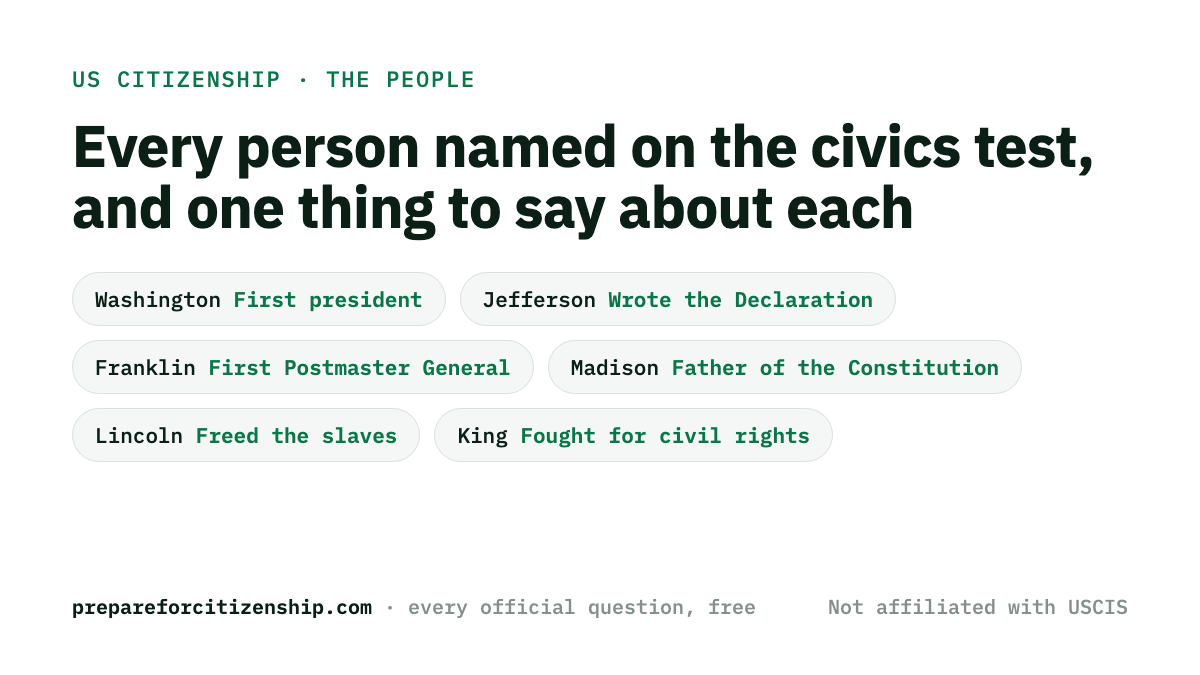
The history section of the civics test is mostly people. Fifteen names appear across the 2025 questions, and for most of them the question is the same: this person is famous for many things, name one. You do not need the whole biography. You need one accepted answer per name, said with confidence. Here is one for each.
The founders
- George Washington. First president of the United States. Also accepted: Father of Our Country; general of the Continental Army; president of the Constitutional Convention.
- Thomas Jefferson. Wrote the Declaration of Independence. He is also the answer to a second question, who wrote the Declaration of Independence, so this one fact covers two questions. Also accepted: third president; the Louisiana Purchase; first Secretary of State.
- Benjamin Franklin. First Postmaster General of the United States. Also accepted: founded the first free public libraries; helped write the Declaration of Independence; inventor; U.S. diplomat.
- James Madison. Father of the Constitution. Also accepted: fourth president; president during the War of 1812; one of the writers of the Federalist Papers.
- Alexander Hamilton. First Secretary of the Treasury. Also accepted: one of the writers of the Federalist Papers; helped establish the First Bank of the United States; aide to General Washington.
- John Jay. Appears only as one of the writers of the Federalist Papers, alongside Madison and Hamilton. The pen name Publius is also accepted for that question.
The 1800s
- Abraham Lincoln. Freed the slaves. Also accepted: saved the Union; led the United States during the Civil War; 16th president; delivered the Gettysburg Address.
- Leaders of the women's rights movement in the 1800s. Susan B. Anthony is the accepted answer most people know. Also accepted: Elizabeth Cady Stanton, Sojourner Truth, Harriet Tubman, Lucretia Mott. The question asks for one.
The 1900s
- Franklin Roosevelt. President during the Great Depression and World War II. That is the whole question, so Roosevelt is the whole answer.
- Dwight Eisenhower. General during World War II. Also accepted: president at the end of the Korean War; 34th president; signed the 1956 Federal-Aid Highway Act.
- Martin Luther King, Jr. Fought for civil rights. Also accepted: worked for equality for all Americans.
How to hold fifteen names
Group them the way the test does. Six founders, all tied to two documents: the Declaration of 1776 and the Constitution of 1787. Lincoln and the women's movement in the 1800s. Roosevelt, Eisenhower and King in the 1900s, one each for the Depression and the war, the war and the highways, and civil rights.
Then pick your one fact per person and say it out loud until it is automatic. Franklin is the one people stumble on because none of his answers is a presidency. "First Postmaster General" is short and accepted. Learn that and move on.
The 2008 test names a different set, including Susan B. Anthony as a stand-alone question. If USCIS received your N-400 before October 20, 2025, study the 2008 list instead.
Frequently asked questions
Who wrote the Declaration of Independence, according to the civics test?
Thomas Jefferson. Jefferson is also an accepted answer for the question about what he is famous for.
Who was president during the Great Depression and World War II?
Franklin Roosevelt.
Who are the accepted answers for a leader of the women's rights movement in the 1800s?
Susan B. Anthony, Elizabeth Cady Stanton, Sojourner Truth, Harriet Tubman or Lucretia Mott. You need one.
Study the official questions, free
Both versions of the civics test, the answers for your state, and practice tests in the real format with the real pass line.
Prepare for Citizenship teaches the test; it does not advise on applications. Anything about your own case belongs with your lawyer or USCIS. Spotted something wrong? Tell us.